
Varg Vikernes is an arsonist, a nationalist-extremist, and a convicted murderer. Many people have a hard time relating to him.
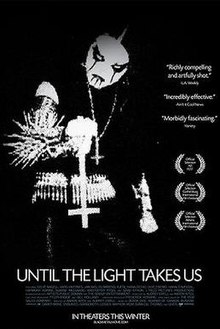
However, in Until the Light Takes Us (2009), it's easy to feel for Mr. Vikernes when he says:
“It’s hard to know what to do to oppose something, because dissident voices are not tolerated in contemporary society."He utters the line with this calm, poignant hesitance—I get the feeling that he's humbled by his own conclusion, which comes after a young adulthood spent experimenting with music and violence as methods of expressing opposition.
But what is it that Vikernes disapproves of?
 Well, he obviously doesn't like Christianity. The most famous chapter from Vikernes's life as a dissident is, of course,
burning down all those stave churches. However, in the documentary—and elsewhere—Vikernes makes it very clear that he is not a Satanist: he does not subscribe to the Christian cosmology, nor does he identify with the Christian conception of evil.
Well, he obviously doesn't like Christianity. The most famous chapter from Vikernes's life as a dissident is, of course,
burning down all those stave churches. However, in the documentary—and elsewhere—Vikernes makes it very clear that he is not a Satanist: he does not subscribe to the Christian cosmology, nor does he identify with the Christian conception of evil.Instead, he sees himself as a Norseman—somebody who has been deprived of his true culture by Christian imperialism.
Vikernes also believes that his traditional culture is being continually undermined by global capitalism, which he blames on U.S. corporations. In the documentary, Vikernes recalls how he expressed his opposition to the spread of American consumerism by shooting out the windows of a newly constructed McDonalds with a shotgun.
Vikernes's direct radical actions were unquestionably more high-stakes than his music. They were probably more effective than his music at bringing attention to his beliefs and concerns: as the church burnings demonstrate, oftentimes if you do something very violent, then people will want an explanation. However, the same can hold true for making weird art.
Early Burzum evinces disgust for the conventions of commercial music in a variety of ways that should be predictable, even to those who are unfamiliar with extreme music: untraditional songwriting (i.e., traditional black metal songwriting), a garage-band recording aesthetic, and lyrics/song titles written in Norwegian (which is relatively rare among the more famous Norwegian black metal bands).
So Burzum's style matches its substance. Great. So What? Well, Vikernes didn't seriously believe that his music was going to be directly responsible for driving American and/or Christian imperialism out of Norway, but if nothing else, the music does serve as a marching beat for the cause which it purports to promote.
Yet in Until the Light Takes Us, the music is more of a backstory than a main character; for the most part, the soundtrack isn't even black metal. Like the media's coverage of black metal in the 90's, the documentary focuses on the visual aspect of the scene: murders and corpsepaint and churches in flames, visual art.
And justifiably so: without all of the blood and fire, the early Norwegian Black Metal scene appears to be a game played for pretty low stakes—nothing more than a bunch of evil hipsters making noise and going to photoshoots dressed up like the offspring of blenders and mimes. Without all the violence and the politics, why should anybody care? What is the purpose of black metal?
There's no authoritative organization or individual who can answer that question, and therefore when I speak of the tradition having a "purpose," I am using figurative language. More precisely, the question at hand might be phrased as What are the causes and effects of black metal? which necessitates an exploration of the question What is black metal? When reflecting on the history of art and radical politics, what does the existence of black metal indicate? What are its consequences?
I began this discussion with Mr. Varg Vikernes because he has posed a fascinating question—"What can we do to oppose to something?"—and he has also explored violence and art as methods of opposition. As an artist and an activist, Vikernes serves as a portal to questions concerning the relationship between these two methods, and their effectiveness.
These questions should be extended beyond Vikernes' biography, and beyond black metal. What do people do to oppose things? What's the purpose of opposition? What are the differences between the consequences of art-as-dissent and violence-as-dissent?
-
As a musical style, black metal is distinct, and can exist independently of any cultural theologizing. However, as a cultural event, black metal depends upon its position within its overculture in order to be the "black metal" that we know today. Like every other anti-art movement or wave, black metal is weird because it needs to be weird: black metal's marginal status is an integral part of the genre. If black metal were to suddenly become popular to the mainstream, then it would cease to be black metal as we understand it.
Being a black metal participant (that is, being a musician or a fan) involves a set of consequences—a definite social positioning. A black metal fan enjoys (or affects to enjoy) a musical style that is intentionally antithetical to long-standing normative aesthetics of beauty. By appreciating black metal in whatever form that might take—playing in a band, buying records, or even just having a few albums in iTunes—the participant cannot help but perpetuate the tradition, keep the thing alive and moving.

No comments:
Post a Comment