
Dry Thesis
Lars Von Trier's Melancholia (2011) uses the attitudes of Claire (Charlotte Gainsbourg) and Justine (Kirsten Dunst) to explore the conflict between individuals and traditional social rituals, as embodied in the wedding reception of Chapter 1. The film ultimately sympathizes with Justine's (Kirsten Dunst) inability to integrate into normative social behavior due to her incapacitating depression, and so sympathizing, the film promotes the creation of one's own rituals and rejecting established social order.
Claire
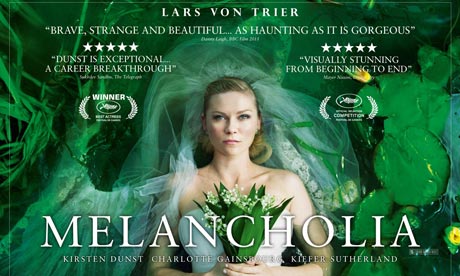 Claire's (Charlotte Gainsbourg) response to armageddon involves drinking wine on the terrace with what remains of her family and listening to Beethoven—a death in keeping with her role as the film's ordering force. Claire is someone who functions by means of tradition and ritual—a practitioner of what A.O. Scott aptly calls "anxious practicality."
To Illustrate: throughout Part 1, Claire keeps the wedding reception moving along, scolding Justine (Kirsten Dunst) for her tardiness. Later on, Claire steps into the role of a disciplinary parent by warning Justine to not react to their mother's provocation during the titillating toast scene. Throughout the ceremony, Claire herds the guests from one activity to another according to the schedule of events. When Justine does not throw the wedding bouquet down to the guests in a symbolic refusal to perpetuate the tradition of marriage, Claire steps in and throws the flowers for her. For Claire, the show must go on.
In Part 2, Claire's tendency to order-through-ritual is less overt, but still present: she attempts to alleviate Justine's illness with bathing and family dinners. As planet Melancholia gets closer and closer, Claire purchases drugs for killing herself and her family, apparently preferring to die "in control" rather than with everybody else. Finally, we have the proposed final glass of wine. "I want to do this the right way," she says. "[It] would make me happy." Correctness is paramount.
Justine
While Claire struggles to organize and control the wedding reception, and then the apocalypse, Justine repeatedly breaks under social pressures and violates tradition. She is two hours late to her own party, which she leaves far too often. Justine delays Claire's schedule further by taking a nap, and then again with a bath.
Although Justine does appear to submit to the wedding ritual (or, at least, grudging acquiescing to it), we see how her acceptance of certain aspects of the ceremony violate other traditions: Justine agrees to wear the wedding dress, which then forces her to pee on the golf course. The dress, then, functions as an instrument of tradition enforcing itself, but in that enforcing there is the opportunity for disruption.
Although Justine does appear to submit to the wedding ritual (or, at least, grudging acquiescing to it), we see how her acceptance of certain aspects of the ceremony violate other traditions: Justine agrees to wear the wedding dress, which then forces her to pee on the golf course. The dress, then, functions as an instrument of tradition enforcing itself, but in that enforcing there is the opportunity for disruption.
In
Part Two, Justine spits out the meatloaf, eats only jam from handpicked
berries with her fingers, and in what I consider to be the film's only
truly erotic moment, she lays naked and touches herself while bathing in
the light of the planet that has been named for her mental
condition—Melancholia—as though embracing her deviant and
individualistic emotional state in a way her sister Claire and
brother-in-law John are unable to do.
Ritual
The insensitively harsh tone Justine takes when rejecting Claire's wine-on-the-terrace-while-we die plan can alienate the audience in the same way that Gaby (the mother) villainizes herself by her rude honesty during the wedding toasts. I can imagine some audiences asking, "Why can't these people just repress themselves so that everybody else can have a good time?" while others will applaud Gaby and Justine for resisting conformity. There is something to be said for both submitting to and resisting benign-but-shallow social rituals, but I think that the film ultimately sides with Justine's (and Gaby's) anomie.

Listening to the grandfather of Western music and drinking the cellar's oldest bottle of wine might be a nice way to spend a privileged Sunday afternoon, but, Justine suggests, this activity is inappropriately banal when life on earth is about to flicker out—just another ceremony to endure, to get through. "I've got to pull myself together," Justine mutters to Claire in Part 1, when she is still intent on enduring her party. No such pulling together is necessary during the task of building the magic cave, Justine's own ceremony. The advantage of the world ending is that there is no need to perform, no high score to achieve.
Questions
Per Juul Carlson writes that Von Triers says Melancholia is not about "the end of the world," but about "humans acting and reacting under pressure." Claire and Justine have drastically different ways of dealing with the pressure, and one of the primary questions that the film invites us to ask ourselves is, "Which sister am I when?"
Which "rituals"—such as parties, smiling, sex, drinking, to name some examples from the film—do we feel obliged to participate in, and who are we disappointing when we fail to do so?
When
do we use methods that have been handed down to us by tradition to
engender happiness or to assuage sadness, and how effective are they,
really? When and where can we reinvent (build our own "magic caves"), and to what end?
Many of the particulars of Justine's circumstance can be traced back to her being a woman. Do we ever find ourselves caught up in rituals that we wouldn't have to deal with if we belonged to a different social category?

No comments:
Post a Comment